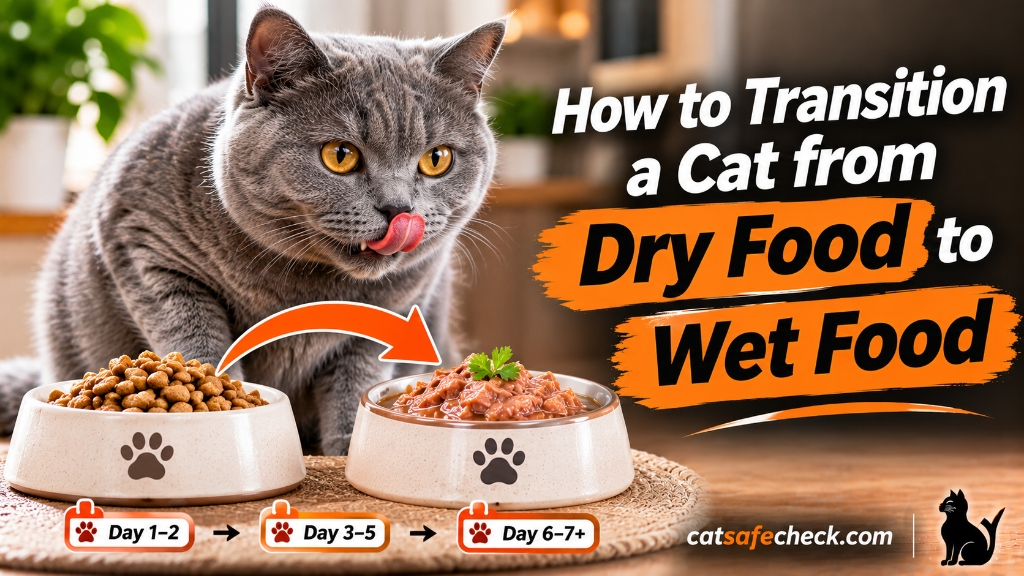
Quick Verdict: How to transition a cat from dry food to wet food
Transitioning a cat from dry kibble to wet food should take 10 to 14 days to prevent osmotic diarrhoea and behavioural food refusal. Senior cats need warmed food and savory toppers, while kittens often experience transient soft stools as their gut microbiome adapts to high moisture.
Key Takeaways for Cat Owners
- Never starve a cat into eating wet food; 48 hours without food can trigger fatal feline hepatic lipidosis.
- Transition over 10 to 14 days using a graduated ratio: 25% wet on days 1-3, 50% on days 4-7, 75% on days 8-10, 100% on day 11.
- Senior cats have dulled olfactory senses; warm canned food to 101°F to unlock aromatic fatty acids.
- Kitten soft stool during a wet food switch is usually benign osmotic adaptation that resolves within 5 days.
- Cats on 100% wet food drink far less water from bowls because canned food is 78% moisture.
Interactive Clinical Tools
Step-by-step transition schedule for picky senior cats
Cats develop strong textural preferences early in life. A senior cat fed dry kibble for 10 years may not recognize wet pate as food. Furthermore, commercial kibble is sprayed with rendered animal fat digests ("palatants") that create an addictive crunch.
Start by establishing scheduled meal times instead of free-feeding. Once your cat is accustomed to eating two to three times daily, introduce a teaspoon of wet food on a separate flat plate next to their kibble bowl. Do not force them to eat it.
Warm the wet food in the microwave for 5 to 7 seconds until it reaches 101°F (normal feline body temperature). This releases volatile fatty acid aromas that stimulate senior appetites. Dust the top with crushed freeze-dried chicken or Purina FortiFlora probiotic powder.
| Transition Phase | Dry Kibble Ratio | Wet Food Ratio | Target Duration |
|---|---|---|---|
| Phase 1: Introduction | 75% of calories | 25% of calories | Days 1 to 3 |
| Phase 2: Halfway Mark | 50% of calories | 50% of calories | Days 4 to 7 |
| Phase 3: Dominant Wet | 25% of calories | 75% of calories | Days 8 to 10 |
| Phase 4: Full Transition | 0% (Optional treats) | 100% wet food | Day 11 onwards |
Kitten soft stool and water bowl myths explained
If your kitten develops soft, pudding-like stools when you introduce wet canned food, do not panic. Moving from dry food (10% water) to canned food (78% water) draws additional moisture into the colon before the kitten's intestinal villi adapt their water-absorption capacity. As long as the kitten is energetic and eating, give the gut 3 to 5 days to normalize.
Many owners become worried when their cat stops drinking from water bowls after switching to canned food. This is completely natural. A cat eating 6 ounces of canned food takes in roughly 4.7 ounces of biological water daily, fulfilling over 80% of their total physiological hydration needs.
Frequently Asked Questions
Why won't my cat eat wet food from the refrigerator?
Cold food straight from the fridge smells like dead, stale prey to a cat. Always warm refrigerated canned food to room temperature or body temperature before serving.
How long can wet food sit in the bowl before spoiling?
Wet food should not sit out longer than 30 to 45 minutes at room temperature to prevent bacterial growth and drying.
Calculate Safe Dosing & Risk · How to transition a cat from dry food to wet food
Safe Human Food Dose Estimator
Compute maximum daily gram limits for safe human food treats while respecting the strict 10% caloric ceiling.
Feline Toxicity Risk Calculator
Select a toxin, exposure pathway, and cat body weight to review organ mechanism and immediate veterinary intervention steps.
Cat Calorie Calculator
Calculate exact daily caloric requirements (RER/DER) and wet vs. dry gram portions tailored to your cat’s weight and life stage.